
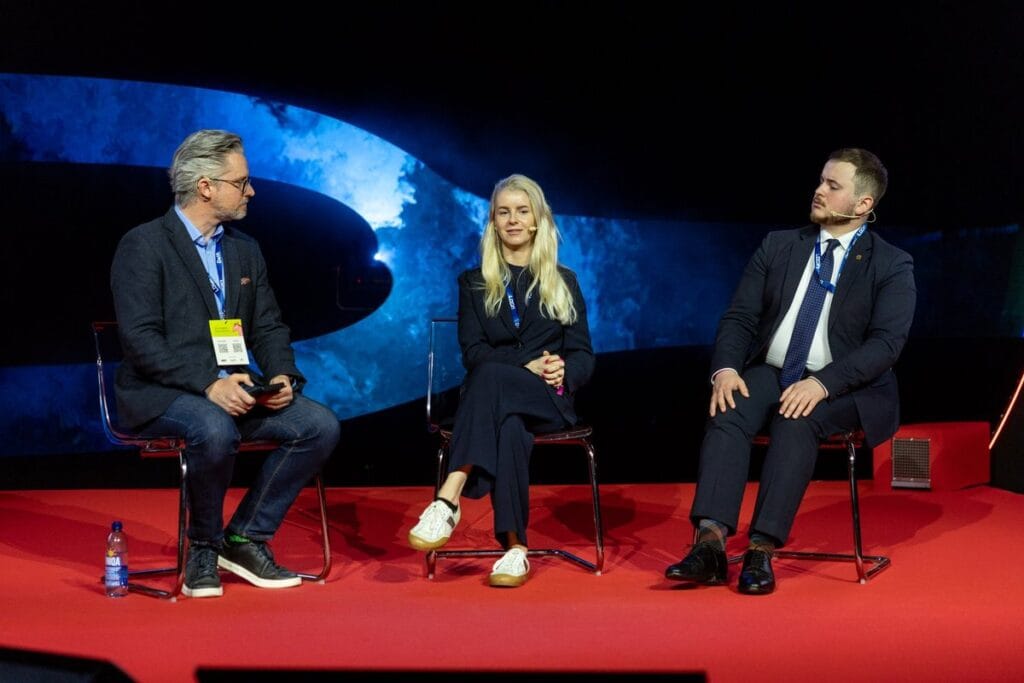
Are young people really no longer interested in the news? Or perhaps the problem lies not in young people’s attitudes, but in changing information consumption habits? These questions were discussed at the debate ‘Young People and the News: Between Panic, Stereotypes and Reality’, organised by the Media Support Fund and held at the LOGIN innovation and technology festival.
The discussion was attended by Dr Patricija Lenčiauskienė, PhD in Communication and Information Sciences, a researcher at Vytautas Magnus University and founder of the organisation “Mediasensus”, and Umberto Masi, President of the Lithuanian Youth Organisations Council (LiJOT). The discussion was moderated by Ruslanas Iržikevičius, Director of the Media Support Fund.
The discussion aimed to examine young people’s relationship with the news not through the prism of moral panic or established stereotypes, but based on research, practical experience and the actual way young people consume information.
Young people are interested in the news, but they discover it differently
According to Dr Patricija Lenčiauskienė, who has researched the information consumption habits of 15–17-year-olds, the claim often repeated in the public sphere that young people are not interested in the news is inaccurate.
“Young people care about what is happening in Lithuania and around the world, but they access news through different channels than previous generations. A large proportion of the information reaches them via social media, and important sources of information include not only journalists, but also social activists, opinion leaders and other individuals with whom they identify,” noted the researcher.
However, the study also revealed another important aspect – some young people who claim that traditional media does not interest them often lack a clear understanding of how professional journalism differs from the information disseminated on social media. This highlights a significant need for media literacy and awareness.
Social media has become the main gateway to information
Participants in the discussion agreed that social media has now become the main space where young people consume information. The speakers highlighted ‘TikTok’ as one of the most important platforms.
According to Umberto Masi, a survey conducted by the Lithuanian Youth Organisations Council shows that three out of four young people are most easily reached via this platform.
“If we want to talk to young people, we need to understand where they are. By informing young people in ways that seem normal or correct to us, we often simply fail to reach them today,” said U. Masi.
However, simply moving content to social media does not solve the problem. The content young people see depends on algorithms, so the media and institutions must find new ways to connect with their audience and hold their attention.
How can we reach young people without compromising journalistic standards?
During the discussion, much attention was paid to the question of how professional journalism can adapt to new information consumption habits without losing its values.
According to Dr P. Lenčiauskienė, some foreign media outlets are already experimenting with new formats and have journalists who present news in a language and format that young people can understand. However, this process is not straightforward.
The social media environment is dominated by short, quickly consumed content, so journalists have to strike a balance between the accuracy of information, context and the audience’s attention.
“It is important to go where young people are, whilst at the same time upholding the principles of professional journalism. Even reliable information presented in a shorter format is a better alternative than purely entertaining or unverified content,” said the researcher.
Participants in the discussion also emphasised the importance of direct contact. Young people who visit media newsrooms and see the news production process up close often begin to view the work of journalists and the significance of professional information in a different light.
How can we cultivate the habit of paying for quality information?
When discussing the relationship between young people and the media, considerable attention was also paid to the economic aspect.
U. Masi pointed out that young people are interested in important global events, but some high-quality content remains inaccessible to them due to paid subscriptions.
Ruslanas Iržikevičius, Director of the Media Support Fund, raised the idea during the discussion of considering an initiative to provide Lithuanian media subscription vouchers for young people.
According to him, one of the growing problems is that a generation is coming of age that is not accustomed to paying for news and, when faced with a paywall, often simply chooses not to read the information.
“If we want to preserve a strong, professional and independent media, we must think not only about media literacy, but also about the understanding that quality information has value. One possible solution could be subscription vouchers, which would allow young people to familiarise themselves with professional media content and experience its value,” said R. Iržikevičius.
The participants in the discussion also supported this idea, emphasising that practical exposure to quality journalism could be one of the most effective ways to foster a long-term relationship with reliable information.
The most important thing is not the platform, but trust
Summing up the discussion, the speakers agreed that the relationship between young people and the news is not as simple as it is often portrayed in the public sphere.
Young people are not detached from the processes taking place in society – they simply discover, evaluate and consume information differently from previous generations. Therefore, the main challenge today is not only to adapt to new platforms, but also to maintain trust in professional journalism.
“The problem is not simply that platforms or formats are changing. What matters most is that the ways in which people discover information, evaluate it and decide what to trust are changing too. Therefore, the question today is not whether young people are interested in the news. What is far more important is how we will ensure that reliable, high-quality and professional information remains accessible and relevant to new generations,” summarised Ruslanas Iržikevičius, Director of the Media Support Fund.
The discussion showed that when talking about young people and the news, it is worth relying less on stereotypes and paying more attention to the actual experiences of young people. It is precisely the ability to understand these changes that will determine whether, in the future, we will be able to maintain a strong media sector that is important to society and reaches a young audience.